(800) 823-4937
 sales@northernhydraulics.net

How to Size a Log Splitter: Tonnage by Log Diameter
June 11, 2026
Most homeowners splitting seasoned firewood need a 20 to 25 ton log splitter. Drop to about 4 to 7 ton for small softwood rounds, and step up to 27 ton or more for big, knotty hardwood like oak or elm. Tonnage is the headline number, but the size that matters is a chain: log diameter and species set the tonnage, the tonnage sizes the cylinder, the two-stage pump GPM sets how fast the ram cycles, and the engine has to drive that pump. Size each link and you buy the right machine once. This guide walks the chain in order, with the tonnage table up top.
Have a part number or specs? We’ll confirm the fit and quote it.
What “size” really means on a log splitter
Ask “what size log splitter do I need” and most answers give you one number: tons. Tonnage is the force the ram pushes the log into the wedge, and it is the spec that decides whether the machine splits your wood at all. But a splitter that hits the tonnage and resets slowly, or stalls because the engine cannot drive the pump, is still the wrong size for the job.
Treat sizing as a short decision chain. The wood you split sets the tonnage. The tonnage sets the cylinder bore. The two-stage pump GPM sets how fast that cylinder cycles. The engine or motor has to supply enough power to run the pump at pressure. Mobility and orientation decide how you feed it. Get the first link right and the rest follow. The figure below lays out the chain; the sections after it size each step. If you would rather shop by the finished machine, start with the log splitters category and bring the numbers back here.

Tonnage by log diameter and species
Start with the largest, hardest log you will actually split, not the average one. Two things drive the tonnage you need: how wide the round is, and how dense the wood is. The table maps both to a working range. Treat the numbers as a sizing rule of thumb, not a guaranteed spec.
| Log diameter | Softwood (pine, spruce, cedar) | Hardwood (oak, maple, ash) | Notes |
|---|---|---|---|
| Up to 6 in | ~4–7 ton | ~10–12 ton | Branch wood and small rounds; an electric splitter handles most of this |
| 6–12 in | ~10–16 ton | ~20–25 ton | The everyday homeowner range; 20–25 ton covers most seasoned firewood |
| 12–18 in | ~20–22 ton | ~25–27 ton | Size up for green or knotty wood |
| 18–24 in | ~22–25 ton | ~27–30 ton | Large rounds; a vertical or H/V splitter saves you lifting them |
| 24 in and up | ~25–27 ton | ~30–37 ton | Crotch wood and elm split hardest; size to the worst log |
Species changes the answer as much as diameter. Softwoods such as pine, spruce, and cedar split with little force. Dense hardwoods such as oak, hard maple, and hickory need more. That density is what the Janka hardness scale measures, published in the USDA Forest Products Laboratory’s Wood Handbook. Hardness is not the whole story, though. Elm, sweetgum, and crotch wood have interlocking grain that splits far harder than their Janka number suggests, so size up when you burn them. Green, unseasoned wood also resists more than dry.
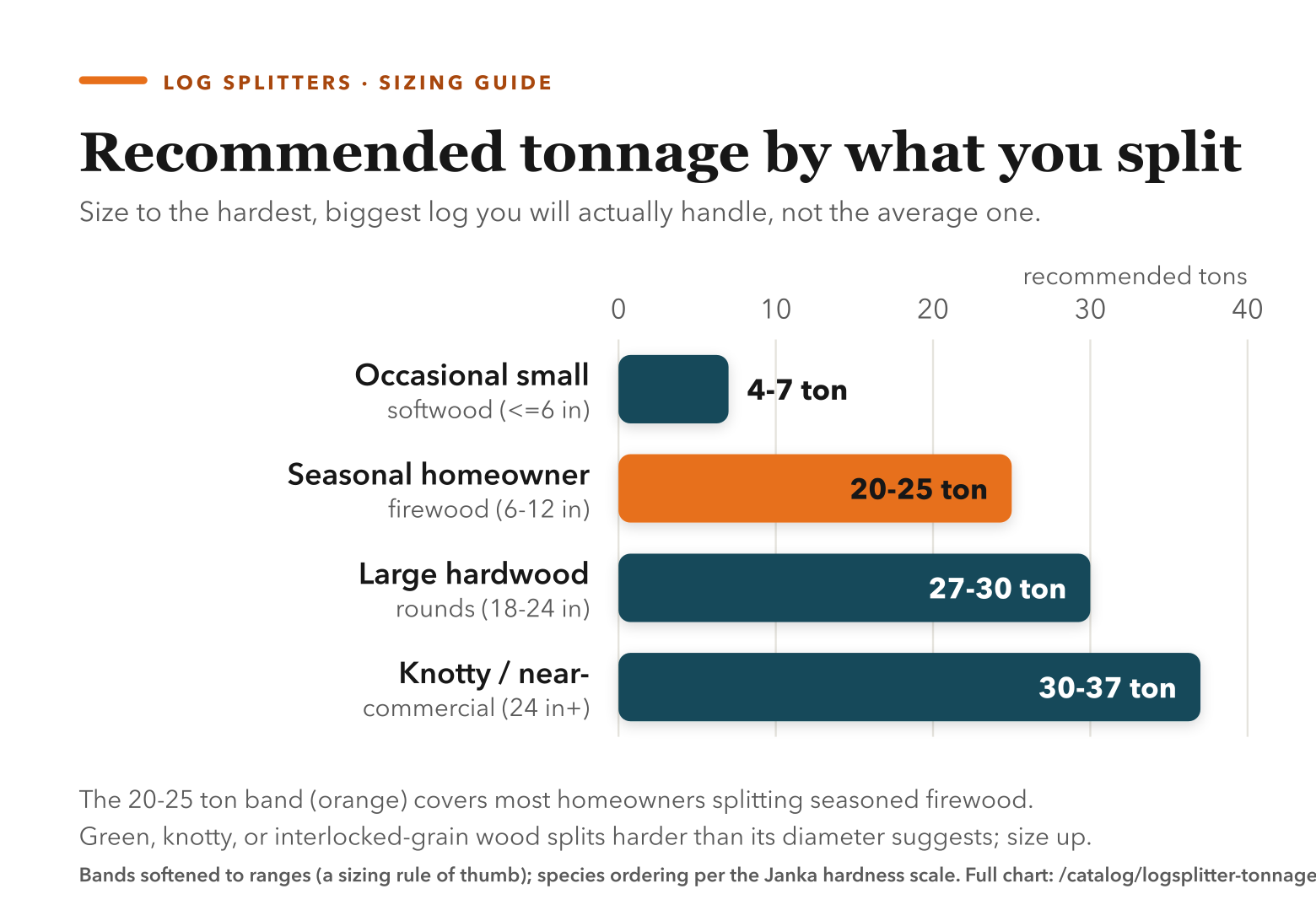
This pillar gives you the working ranges; for the full look-up by tonnage, see our dedicated log splitter tonnage chart. The figure below shows the same answer as a quick magnitude ladder by what you split.
Cycle time: how fast the ram resets
Cycle time is the seconds the ram takes to extend, split the log, and retract. It is the speed spec, and it decides how many cords you process per hour once the tonnage is sorted. A consumer two-stage splitter commonly runs a full cycle in the low double digits of seconds; faster machines reset quicker and move more wood. Two specs set it: the pump GPM (more flow, faster travel) and the cylinder bore and stroke (a bigger cylinder needs more oil to fill, which slows the cycle for the same flow).
There is a trade-off. A long stroke handles long rounds but adds cycle time; a faster cycle from higher GPM costs more pump and engine. For most firewood, a mid-range cycle is the right balance. Cycle time also drifts as the machine ages: low or aerated oil, a worn pump, or a sticking valve all slow it down, so keep up with log splitter maintenance to hold the speed you paid for.
Two-stage pump GPM: where the tonnage comes from
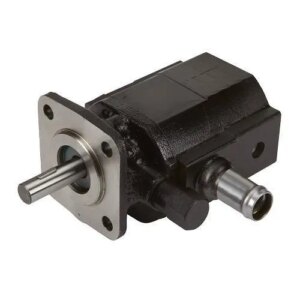
The two-stage pump is what makes a hydraulic splitter both fast and strong. It runs in two modes. Under light load it moves a lot of oil at low pressure, so the ram advances quickly toward the log. When the wedge meets resistance and pressure climbs past the pump’s shift point, it drops to a low flow at high pressure to build the splitting force. That shift is why a small engine can still produce big tonnage: it only needs the power at full pressure for the moment the wood actually breaks.
GPM is the number to match. More flow fills the cylinder faster, which raises ram speed and shortens cycle time at a given tonnage. The table pairs typical pump output to a splitter class and engine. Size the pump, the cylinder, and the relief pressure together so the rated tonnage is real, not theoretical. Browse output ratings in the two-stage pumps subcategory.
| Two-stage pump GPM | Typical splitter class | Ram speed feel | Engine pairing |
|---|---|---|---|
| ~11 GPM | Entry / electric-equivalent | Slower cycle, fine for occasional use | ~5–6.5 HP gas or electric |
| ~16 GPM | Mid homeowner (20–25 ton) | Balanced cycle for seasonal firewood | ~6.5–9 HP gas |
| ~22 GPM | Heavy / fast-cycle (25–35 ton) | Fast reset for higher volume | ~9–14 HP gas |
| 28 GPM and up | Commercial / processor-fed | Fastest reset; larger valve and cylinder | ~14 HP and up |
Engine or motor HP: sizing the power
The engine does not split the wood. It drives the pump, and the pump splits the wood. So size the engine to the flow and pressure you need, not to the tonnage directly. Hydraulic power follows a fixed relation: horsepower equals GPM times PSI divided by 1714, a standard formula you can check at The Engineering ToolBox. Run the math at your relief pressure and full flow, then add a margin for friction and the engine’s real-world output, and you have the minimum HP.
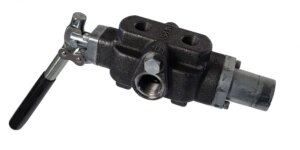
In practice, electric splitters use a 1.5 to 2 HP motor for small indoor or near-house work, and gas engines run from about 5 HP on entry machines to 14 HP and up on fast, high-tonnage units. The other half of the powered package is the control valve, usually an auto-return detent valve that retracts the ram hands-free at the end of the stroke. Match the valve flow rating to the pump GPM so it is not the bottleneck; see the log splitter valves subcategory for detent and auto-return options.
Mobility and orientation: horizontal, vertical, portable
The last link in the chain is how you feed the machine. Orientation comes three ways. A horizontal splitter is fine when you can lift rounds onto the beam. A vertical splitter lets you roll a heavy round under the wedge without lifting, which matters past about 18 inches. A horizontal/vertical (H/V) machine does both and is the common choice for mixed wood. Match the orientation to the largest rounds you handle, because lifting a 24 inch oak round onto a waist-high beam is the part that ends a session early.
Mobility is the other call. A tow-behind splitter on a highway-rated axle moves between a woodlot and the house; a stationary or small-wheel unit stays put near the woodpile. Heavier, faster machines are usually tow-behind because the engine and pump add weight. For the wider buying and efficiency picture, our guide to log splitter safety and efficiency covers feed setup and run-time habits, and the log splitter FAQ answers the common operating questions.
Pick your splitter (or build one)
With the chain sized, the choice narrows to a few clear cases. Match yours and you have your machine.
Pick a small electric or low-tonnage unit when you split mostly softwood under about 6 inches, work near power, and want a quiet machine with no engine upkeep. Four to seven ton is plenty, and the slower cycle does not matter at low volume.
Pick a mid 20 to 25 ton gas splitter when you process a few cords of seasoned firewood a year up to roughly 12 inches. This is the homeowner default: enough force for most hardwood, a balanced cycle, and usually an H/V frame so you are not lifting the big rounds.
Pick a heavy 27 ton or larger machine when you split big rounds, green or knotty hardwood, or higher volume. Pair the tonnage with a higher-GPM pump and a bigger engine so the cycle stays quick, and lean vertical for the largest wood.
Build your own when you have a frame, an engine, or a tractor’s hydraulics and want to spec the components. A DIY log splitter build lets you match the cylinder, two-stage pump, and valve to your exact wood and power source. We carry the parts to do it; the full range of finished machines and components is in the log splitters category.
Speccing a build or a multi-component upgrade is the right time to talk to a person. Send the largest log diameter, the wood species, your power source, and the target cycle, and an NH specialist will size the matched cylinder, two-stage pump, and valve as one system. Request a quote to spec your splitter components rather than guessing at single parts.
If it were our call
For most buyers, a 20 to 25 ton splitter with a balanced cycle is the right machine. An H/V frame earns its keep the first time you face a big round. Size the tonnage to the worst log you will actually split, not the average. Knotty elm or a green oak crotch can outrun what the diameter alone suggests, so leave some headroom. From there, treat the rest as a system. A higher-GPM two-stage pump and a bigger engine only pay off if the cylinder and valve are matched to them. Match them and a fast cycle will not stall at the wedge. Split a few cords of seasoned firewood a year? Do not overbuy a commercial machine. Burn big hardwood or run real volume? Do not starve a heavy splitter with an undersized pump. When you are speccing components, a kit, or a build, send us the numbers and browse the log splitters or request a quote before you order.
Frequently Asked Questions (FAQ)
Short answers to what buyers ask most when sizing a log splitter.
What size log splitter do I need?
For most homeowners splitting seasoned firewood up to about 12 inches, a 20 to 25 ton splitter is the right size. Drop to 4 to 7 ton for small softwood, and step up to 27 ton or more for big or knotty hardwood like oak and elm. Size to the largest, hardest log you will actually split, then match the two-stage pump GPM and engine HP to that tonnage. The tonnage chart gives the full look-up.
How big of a log can a 27 ton log splitter handle?
A 27 ton splitter handles most rounds a homeowner sees, including hardwood in the 18 to 24 inch range, as a working rule of thumb. Diameter is only part of it: dry, straight-grained wood splits well at 27 ton, while green, knotty, or interlocked-grain wood of the same size resists more. For 24 inch and larger hardwood on a regular basis, size up toward 30 ton or more and feed it vertically. See the log splitters category for matched machines.
How big of oak logs will a 25 ton splitter split?
A 25 ton splitter will split seasoned oak up to roughly 18 inches comfortably, and larger rounds if the grain is straight and the wood is dry. Oak is dense, so green oak and crotch sections push closer to the machine’s limit. If most of your wood is large oak, a 27 to 30 ton machine gives margin and keeps the cycle from stalling. A two-stage pump sized to the cylinder is what delivers that rated force.
Is a 12 ton log splitter enough?
A 12 ton splitter is enough for small, seasoned softwood and modest hardwood up to about 6 to 10 inches, which suits light, occasional use. It will struggle with large, green, or knotty hardwood, where the ram bogs down or the log will not part. If you burn mostly hardwood or split more than a cord or two a year, step up to 20 to 25 ton. Compare options in the log splitters category.
Is a 9 ton log splitter big enough?
A 9 ton splitter is big enough for small softwood rounds and branch wood up to roughly 10 inches, the kind of light-duty work an electric model is built for. It is not enough for large or dense hardwood. Treat 9 ton as an occasional, near-house machine; for seasonal firewood, plan on more force. If you are unsure, send your wood size and species and we will confirm a size, or request a quote on a matched build.
Is there a log splitter size chart or calculator?
Yes. Our log splitter tonnage chart maps log diameter and species to a recommended ton range so you can look up your exact case, and the table near the top of this page covers the common bands. For component sizing, the two-stage pump GPM and engine HP follow from the tonnage and cycle you choose, as the sections above lay out.